
Ortho.i® AI-First Practice: Why the Future Must Be Modality-Agnostic. Part 1.

From Appliance Loyalty to Intelligence-Centered Orthodontics
The future of orthodontics will not be defined by loyalty to a single appliance, a single material, or a single treatment category. It will be defined by loyalty to diagnosis, patient needs, biological reality, data interpretation, clinical judgment, and measurable outcomes. This is the foundation of the AI-first orthodontic practice: a model in which intelligence guides the selection of treatment workflows rather than the other way around.
For decades, orthodontic identity has often been associated with treatment modality. Some professionals became known as “brand system doctors,” others as “brand aligner doctors,” and more recently, some have positioned themselves around direct printed aligners, in-office aligners, hybrid protocols, or digital orthodontics. Each of these categories has value. Each can be powerful when used in the correct indication. However, none of them should become the central identity of a future-ready orthodontic practice.
Ortho.i® AI-first practice is modality-agnostic. This means it is not braces-first, aligner-first, DPA-first or hybrid-first. It is diagnosis-first, patient-first, data-first, and outcome-first.
The practice does not begin with the question, “How can I treat this patient using clear aligners?” It begins with a more intelligent question: “What is the best workflow, appliance combination, and clinical strategy to achieve the best individualized result for this patient at this moment?”
This shift may sound simple, but it represents a deep transformation in orthodontic thinking. The old model was product-centered. The orthodontist or the practice often built a brand around a preferred appliance system. The new model is intelligence-centered. The orthodontist uses data, artificial intelligence, clinical expertise, patient behavior analysis, financial considerations, operational capacity, and biological principles to design the most appropriate path for each case.
In practical terms, an Ortho.i® AI-first practice uses artificial intelligence to support decision-making across multiple dimensions.
The clinical team evaluates which modality is most appropriate for the patient’s diagnosis, skeletal pattern, dental complexity, periodontal condition, esthetic expectations, age, compliance potential, lifestyle, budget, treatment goals, and operational feasibility. AI does not replace the orthodontist’s judgment. Instead, it helps organize complexity, reveal patterns, support scenario planning, and improve the consistency of decision-making.
This is where modality-agnostic orthodontics becomes especially relevant.
Clear aligners may be the best solution when esthetics, compliance, case selection, patient motivation, and movement predictability are aligned. Fixed appliances may be more appropriate when biomechanics, complexity, anchorage control, or compliance limitations make braces a stronger option. Hybrid treatment may offer the best outcome when aligners and fixed appliances complement each other. Direct printed orthodontics appliances (DPOA) aligners, brackets, retainers, expanders, IDB trays, etc, and remote monitoring, may be ideal when they match the clinical indication, patient profile, and business model of the practice.
The point is not to diminish any modality.
The point is to place each modality in its proper role. Appliances are instruments. Intelligence is the system. The orthodontist should not be loyal to the appliance. The orthodontist should be loyal to the diagnosis, the patient, the data, and the result.
Market evolution reinforces this mindset. Clear aligners continue to grow and represent a major force in orthodontics, but fixed appliances remain highly relevant, especially in complex cases and in patients where compliance is uncertain. Our perspective recognizes that clear aligners have evolved from being perceived as limited or inferior into a major digital system with significant future dominance potential, while fixed appliances continue to play an essential role and must also evolve toward hybrid, digital, customized, and AI-integrated workflows.
This is why the future is a transition from appliance-centered orthodontics to intelligence-centered orthodontics. In this new model, the competitive advantage is not simply owning a certain technology. The advantage is knowing when, why, and how to use the right technology for the right patient in the right workflow.
While many organizations continue to follow the AI-after pattern, adding new technologies in to existing workflows and processes, often struggling with customer adoption and retention, Ortho.i® has taken a different path.
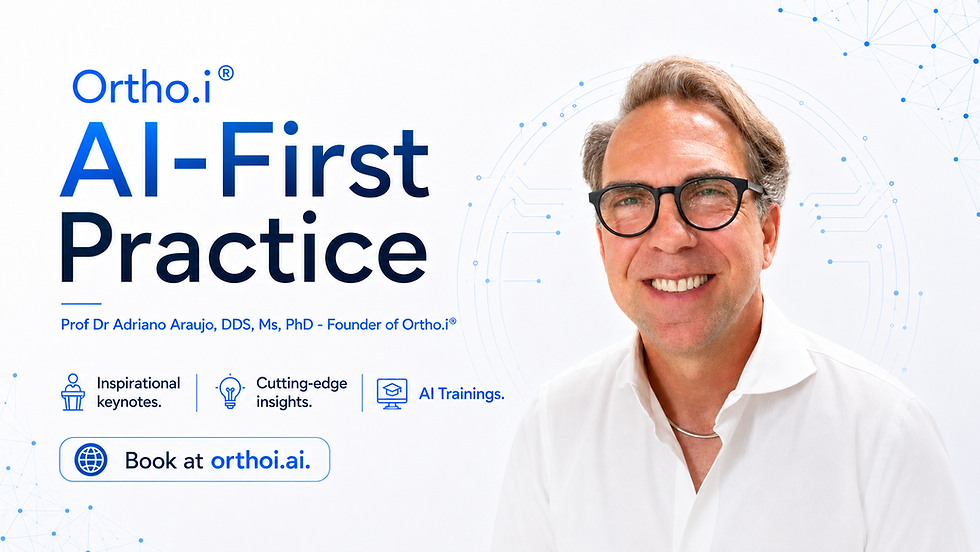
We have learned from this transition and developed a structured educational process, from keynotes presentation to continued education to help shorten the journey from digital orthodontics to generative orthodontics through a Human-AI teaming framework.
Our approach starts with people first. We help associations, organizations and practices build the right mindset from the inside out, train their teams and doctors, develop AI leadership, and then scale products and workflows with greater adoption and growth.
The orthodontic companies and practices that lead the future will not be defined by having the most advanced AI technology, but by being led by humans with AI leadership, clinical intelligence, and a clear purpose.
NEXT
This first part of the article establishes the essential mindset shift: the orthodontic practice of the future cannot be built around product identity. It must be built around clinical intelligence.
Part 2 will expand on this foundation by exploring how artificial intelligence, Human-AI collaboration, patient experience, and responsible business strategy can transform this mindset into a practical operating model for the future-ready orthodontic practice.
Ortho.i® We care.


Comments