
Ortho.i® AI-First Practice: Turning Modality-Agnostic Thinking into an AI Operational Model. Part 2.

Once the practice moves beyond appliance loyalty, the next challenge is operational: how to convert this intelligence-centered mindset into a real clinical and business system.
This is where artificial intelligence becomes more than a technological accessory. It becomes a strategic layer that helps the orthodontist organize information, reduce friction, and make better decisions across the entire patient journey.
Artificial intelligence accelerates this transformation because it changes the way information flows through the practice. Traditional orthodontic decision-making often depends on fragmented records, individual experience, manual interpretation, and subjective habits.
AI-first systems can help synthesize patient data, treatment history, imaging, facial analysis, intra-oral scans, compliance patterns, business constraints, and communication needs into a more coherent decision framework. This does not remove uncertainty, but it helps the orthodontist manage uncertainty with greater structure and clarity.
The challenge, therefore, is not only technological. It is educational: how do we prepare orthodontists to work, think, and grow in an AI-first future?
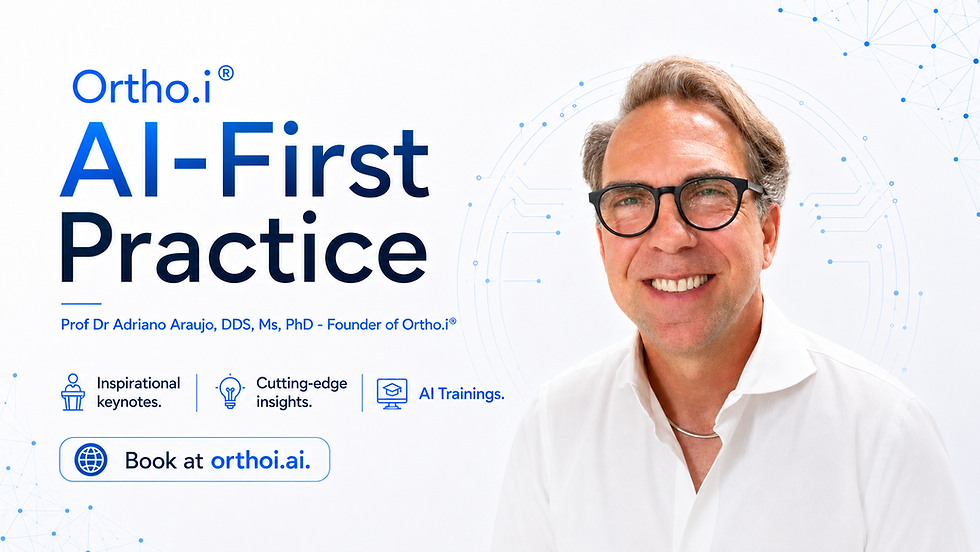
The Ortho.i® educational philosophy is aligned with this future. Within the Ortho.i® Keynote, Prof. Adriano Araujo’s presentation is not a traditional lecture, but a strategic opening framework designed to help doctors and organizations understand the future of orthodontics, connect AI with clinical and business transformation, and prepare their mindset for emerging AI-Agentic environments.
The Ortho.i® Sprint was created as an immersive in-person learning experience combining artificial intelligence, nature, personalization, and purpose to transform how orthodontists see their practices and their professional future. Its methodology emphasizes AI integration, customized learning, strategic planning, responsible implementation, and the development of future-ready practices rather than simply teaching isolated tools.
This distinction matters because technology adoption in orthodontics rarely fails only because the product is weak. It often fails because the practice does not know how to integrate the technology into its culture, team, patient experience, and operational model.
A powerful appliance can underperform in a poorly designed workflow.
A sophisticated digital system can lose value if the team does not understand how to use it.
A new AI tool can create confusion if it is introduced without purpose, training, and governance.
The AI-first orthodontic practice therefore requires more than software. It requires a new mindset, a new education learning methodology but also a new structure. It requires the doctor and the team to become fluent in data, workflow design, patient communication, ethical decision-making, and continuous improvement.
It requires the practice to ask better questions, test assumptions, evaluate outcomes, and adapt protocols based on evidence and experience.
A Leadership Evolution
Ortho.i® AI-first model is deeply human. At first glance, artificial intelligence may appear to be a technical revolution. In reality, it is also a leadership evolution. The orthodontist must learn to lead a Human-AI collaboration model where intelligent systems support diagnosis, planning, operations, education, communication, and business strategy.
The target is not to make the practice less human.
The objective is to reduce cognitive overload, improve consistency, increase efficiency, and allow the orthodontist and team to focus more deeply on the patient experience.
In this context, modality-agnostic does not mean neutral, passive, or indifferent. It means the orthodontist is not trapped by brand identity, vendor pressure, personal bias, or comfort zone.
It means the practice can choose aligners without becoming aligner-dependent, use customized braces without being analog, adopt direct printed aligners without treating every patient as a DPA case, and combine systems when the patient’s biology and goals demand it.This approach will drive sales growth, while delivering a better experience and stronger outcomes for everyone involved.
The future orthodontist will need to become an orchestrator.
This professional will not simply deliver appliances.They will design intelligent treatment ecosystems. Generative Orthodontics capabilities and this evolution from appliance selection to intelligent workflow design naturally leads to a deeper question:
How does this model change the relationship between the orthodontist, the patient, and the long-term future of the practice?
Once AI helps the team organize data, reduce uncertainty, and choose the most appropriate clinical path, the value of the practice is no longer measured only by the technology it offers, but by the trust it creates, the adaptability it builds, and the consistency of the outcomes it can deliver.
In Part 3, we will explore how this shift creates greater trust for patients, more sustainability for orthodontists, and a clearer vision for the future of intelligent, patient-centered orthodontic care.
Ortho.i® We care.
Discover more:
Read Part 1 here: https://www.linkedin.com/pulse/orthoi-ai-first-practice-why-future-must-part-1-marotta-araujo-i2sdc/?trackingId=RHm2ooS1RBKZs6KOESTFmg%3D%3D


Comments